A cow from a dry stretch of forest in Gujarat is the reason a large slice of Brazil's dairy industry runs the way it does today. Sounds like a stretch. It isn't. The Gir cattle breed left Kathiawar over a century ago, landed in South America, and got selectively bred into a milk machine that Indian farmers now fly across the world to buy back. Same animal. Wildly different outcome. And that single fact tells you almost everything about why this breed is so misunderstood at home.
Most people know two things about the Gir cow: it looks a bit odd, and its milk sells for a premium because it's "A2." Both true. Both barely scratch the surface. So let's go past the tourist-brochure version and get into what actually makes this animal worth the money, what a real one looks like versus the fakes flooding the market, and why milk yield numbers swing so hard depending on who's holding the rope.
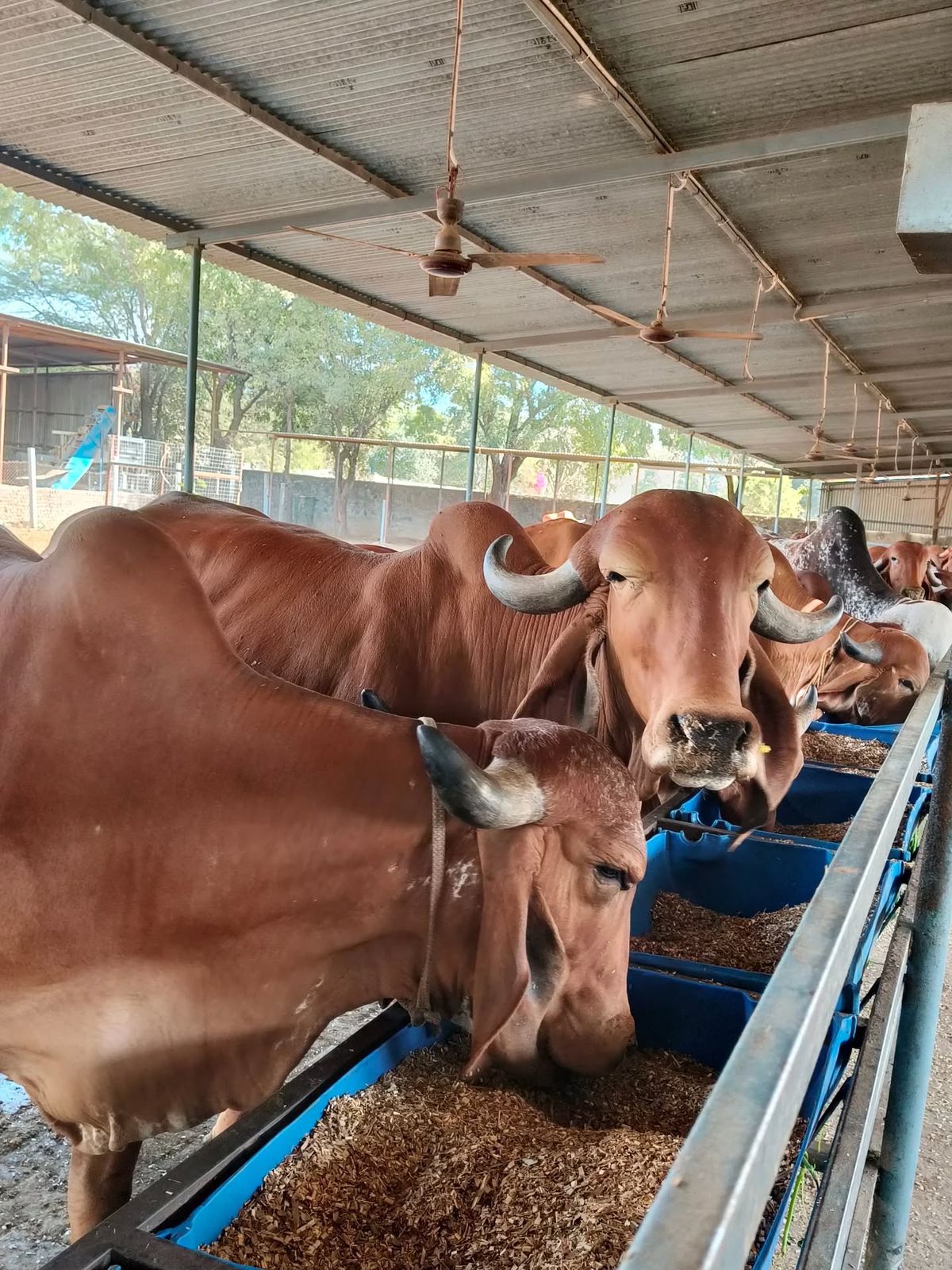
Start with the head. The Gir is the only cow on the planet with a properly ultraconvex forehead, a domed bony shield that bulges outward like a helmet. It's not a cosmetic quirk. That dome and the loose, hanging skin around it help the animal shed heat in brutal Gujarat summers, which is a big part of why the breed shrugs off temperatures that would flatten a Holstein.
Then the ears. Long, drooping, curled inward at the tip and folded over like a leaf with a little knot at the end. Once you've seen a genuine pair, you can't unsee them. The horns sweep back off the head, then curve up and out in a spiral. The coat runs from deep red through mottled patches to near-white, with big irregular splashes of colour. Black is the one shade that shouldn't show up on a purebred at all. Add a heavy hump over the shoulders and a deep, swinging dewlap of loose skin at the throat, and you've got an animal that reads as unmistakably desi from fifty feet away.
The size is moderate, not massive. Cows sit around 385 kg and roughly 130 cm at the shoulder. Bulls run heavier, near 545 kg and a touch taller. Calves drop at about 20 kg. These aren't giant frames, and that matters, because a lot of buyers wrongly assume a bigger cow means more milk. With the Gir, the value is in the package, not the poundage.
The breed comes from the Gir forest and hills of the Saurashtra region, and the districts around it, Junagadh, Amreli, Bhavnagar and Rajkot. That forest gave the breed its name. Depending on which corner of the breeding tract you're standing in, locals might call the same animal Bhodali, Desan, Gujarati, Kathiawari, Sorthi or Surati. If a seller uses one of those names, they're not selling you a different breed. They're selling you a Gir.
This is where money gets lost, so pay attention here more than anywhere else on this page. The market is thick with crossbred animals sold as "pure gir cow" at pure-Gir prices, and most first-time buyers can't spot the difference until the milk pail proves it months later.
The forehead has to dome. A flat or only slightly rounded forehead is a red flag that Holstein or Jersey blood snuck in.
The ears must be long, pendulous, and folded with that knot at the tip. Short or upright ears are wrong.
The hump should be well-developed and sit firmly over the shoulders, not slumped.
The dewlap should hang deep and loose.
Coat colour should sit in the red-to-white range with clear patches, and genuine black across the body is a warning sign, not a rare bonus.
Watch the horns curve back and up.
And check temperament, because a real Gir is calm and people-friendly, not skittish.
One animal ticking four of six boxes isn't pure. It's a crossbreed with good marketing. If the seller won't let you inspect slowly or rushes you toward payment, walk. There are enough honest breeders that you never have to gamble on a pushy one.
Here's the part that gets thrown around as a buzzword by people who couldn't explain it if you paid them. "A2 milk." Fine. What is it, actually?
All cow milk carries a protein called beta-casein. It comes in two main forms, A1 and A2, and the difference is a single amino acid at one position in the chain, proline in A2 versus histidine in A1. That one swap changes how the protein breaks down in your gut. When A1 milk digests, it releases a fragment called BCM-7, and that fragment is what a chunk of people blame for the bloating and discomfort they feel after regular dairy. A2 milk doesn't release it the same way. Plenty of people who think they're lactose intolerant actually do fine on A2, because their problem was never the lactose.
Native Indian humped cattle, the Bos indicus breeds, overwhelmingly carry the A2A2 genotype. The Gir is one of the cleanest examples. Most high-yield foreign breeds carry A1, which is exactly why "A2" became a selling point in the first place: it used to be the normal milk before dairy went industrial.
That gap between a marketing sticker and an actual genotype is the whole reason Sunrise A2 Milk sources from Gir cows instead of the cheaper, higher-volume crossbreds everyone else milks. You can't fake the genetics. Buy A2 from a random shed and you're trusting a label. Buy it tied to a known Gir herd and you're trusting the animal.
On composition, Gir milk runs rich. Fat content sits around 4.5%, noticeably higher than what you get from watery high-volume crossbred milk, which is also why Gir milk makes such prized ghee. The milk is thicker, yellower, and holds up better in traditional dairy. I'll stop short of the health claims you see plastered on some packaging, because a lot of that is oversold. What's solid: it's A2, it's high-fat, and people who react badly to ordinary milk often tolerate it. That's enough. It doesn't need the miracle-cure treatment.
Straight answer, and then the uncomfortable one.
A Gir cow in India typically gives somewhere between 6 and 12 litres a day, with well-kept purebred animals landing at the top of that range. Across a full lactation, the Indian average works out to roughly 1,590 kg, with documented record animals hitting around 3,182 kg at that 4.5% fat. So a good Gir is a solid, dependable milker. Not a flood. A steady, high-quality stream.
Now the part nobody at the cattle market wants to discuss.
The same breed averages around 3,500 kg per lactation in Brazil, and elite Brazilian herds go far beyond that. Read that again. Roughly double the typical Indian figure, from genetically the same animal. This is the single most important thing to understand about the Gir cattle breed, and almost every Indian article glosses right over it.
It's not magic and it's not a different cow. It's selection and management. When the breed reached Brazil, producers treated it like a serious dairy project. They kept obsessive records, bred only from the highest-yielding cows, ran embryo transfer and structured genetics programs, dialled in nutrition, and culled hard for decades. That's how you get the Girolando too, the Gir crossed with Holstein at a 5/8 Holstein to 3/8 Gir ratio, a cross Brazil has been registering since 1989 and that now underpins a big share of its milk.
Back home, most Gir cows are kept the way cattle have always been kept, with modest feed, little to no yield-based selection, and no data. Same genetics, a fraction of the output. So when someone tells you a Gir "only gives 8 litres," what they're really describing is a management ceiling, not the animal's actual potential. The Brazilians proved the ceiling is far higher. That's also why serious Indian dairy farmers now import Brazilian Gir semen and embryos to rebuild the yield their own ancestors had, and quietly let go, generations ago.
Gir cattle are famously easy to be around. Gentle, curious, genuinely fond of human company. Herders in the breeding tract will tell you the cows form a tight circle at night with their calves tucked in the middle, heads resting over the little ones. That docility isn't a soft detail. It makes the animals easy to handle, easy to milk, and safe around children and first-time keepers, which matters far more day to day than most buyers expect.
The hardiness is the other half of the appeal. This breed evolved through drought and scarcity, so it pulls a decent yield out of modest feed and shrugs off the tropical diseases and tick loads that wreck imported cattle. Less vet cost, fewer sick days, lower maintenance overall. The bullocks are strong enough to haul heavy loads across sand, black soil or rock, though in pure draught work some farmers rate Kankrej oxen higher and keep Gir bullocks mainly for their calmer nature.
That combination, tough plus tolerant plus gentle, is exactly why the Gir became an export long before "A2" was a marketing term. The United States, Mexico, Venezuela and Brazil all imported the breed and bred it successfully. In North America it was one of the founding breeds behind the Brahman. The animal that adapts to anything is the animal that ends up everywhere.
If you're weighing an A2 milch cow for your farm in India, the Gir isn't your only real option. The Sahiwal is the other heavyweight, and the Gir helped improve the Sahiwal along the way, so the two are cousins of a sort. Buyers constantly ask which is better, and the honest answer is that it depends on what you want.
The Sahiwal often edges ahead on raw daily yield and is a shade lower-maintenance in the plains of Punjab and its home tract. The Gir gives milk with higher fat, which is why it dominates the premium ghee market, and it handles the dry, hot, rocky conditions of western India better. Sahiwal milk is excellent A2 milk; so is Gir milk. Neither is a mistake.
Pick the Gir if you're after fat-rich milk, top-grade ghee, heat and drought tolerance, and a calm animal that's easy to manage. Lean Sahiwal if pure milk volume and plains-country adaptability sit higher on your list. Anyone claiming one breed simply beats the other across the board is selling you that breed. Both are national treasures for a reason.
Price is where the excitement usually meets reality. There's no single Gir cow price, and any seller quoting you one flat number is skipping the questions that actually set the value.
A modest Gir can start somewhere in the region of Rs 60,000 to Rs 80,000. A healthy, purebred, in-milk cow with a solid pedigree and good daily yield commonly runs into the lakhs, often Rs 1 lakh to Rs 3 lakh, and top pedigree or proven high-yield animals climb well past that. Ranges shift constantly with region, season and demand, so treat these as ballpark, not gospel.
Four things drive the number more than anything else. First, whether she's actually pure, which loops right back to that identification checklist. Second, her current milk yield and how far into her lactation she is, since a cow in peak flow is worth far more than a dry one. Third, her lineage and calving history, because proven, well-bred mothers command a premium. Fourth, plain geography and timing.
A crossbred animal, or one nearing the end of her lactation, dressed up and sold at pure-Gir, peak-yield prices. Protect yourself the boring way. See the cow milked with your own eyes before you pay. Ask for lineage. Bring someone who knows the breed if you don't. Buy from breeders with a name and a reputation to lose. A rushed deal at a "too good to miss" price is almost always the one you'll regret when the pail comes up half empty three weeks later.
Depends entirely on why you want one. If you're chasing the absolute highest litre count per rupee of feed and you're running an intensive plains operation, there are more specialised options. But if you want a genuinely tough animal that thrives on modest care, gives fat-rich A2 milk that people who can't stomach ordinary dairy can actually drink, stays calm enough for a family to handle, and carries genetics that have quietly powered dairy farms on the other side of the world, this breed earns its price.
A Gir heifer takes a long time to become a milking cow. Records from the Cattle Breeding Farm at Junagadh Agricultural University, covering 228 Gir cows and 680 lactations over 24 years, put the average age at first calving at roughly 1,490 days. Other published farm data lands near 1,534. Do the maths on that. It's a bit over four years from birth before she gives you your first drop of milk. A well-managed Holstein calves at two.
That gap is the whole story of Indian dairy in one number.
Then the cycle. Published Gir herd data shows an average inter-calving period near 423 days and a dry period around 123 days, with gestation running about 280 days. She's carrying for nine months, resting for four, and repeating on a fourteen-month loop instead of the twelve-month loop a commercial dairy is built around.
The figure that actually hits your wallet isn't litres per day. It's litres per day of calving interval, and recorded Gir herds sit near 4.98 litres. Read that again. Not 8. Not 12. About five litres a day averaged across every single day she stands on your farm, milking or dry.
Now you know why the dairy boards pushed crossbreds for forty years. And why anyone quoting you "50 litres a day" for a Gir cow - and yes, pages ranking on this keyword right now say exactly that - is either repeating something they never checked or counting on you not to. Total lactation yield in recorded Indian herds averages about 2,063 litres across a 326-day lactation. That's roughly 6.3 litres a day while she's in milk. Good. Not magic.
The counter-argument is strong, though, and it's the reason I'd still buy one. Mortality in recorded Gir herds runs around 3.63%, which is low. Heifers settle on about 1.07 inseminations and cows on about 1.64 - numbers a Holstein sweating through a Rajasthan May won't come close to. She eats less. She gets sick less. Her milk sells for money the crossbred's milk will never see.
The Gir isn't a volume play. It's a margin play. Anyone pitching it as both is selling you something.
Roughly a thousand people a month in India search for a black Kapila Gir cow. That number surprised me enough to go looking. What I found is one of the cleanest myths anyone ever built on purpose.
The Gir standard doesn't allow black. Red through yellow to white, mottled and patched - all fine. A truly black coat puts the animal outside the standard, full stop.
And Kapila is real, revered, and not a Gir. The name traces back to Sage Kapila. Kapila cattle are native to Dakshina Karnataka and Kasaragod, stand about 83 cm at the shoulder, and give somewhere around a litre and a half a day. Tirumala uses Kapila milk for abhishekam. The Golden Kapila variant, with its golden hide and golden eyes, is the most revered of them all. None of that describes a Gir. Different region, a third of the height, a fraction of the milk.
The word itself muddies the water further. In Indian breed naming, "kapila" often just means a uniform coat colour, which is why Goa has a Shweta Kapila - shwet meaning white - and Maharashtra has a Konkan Kapila draught breed. Old texts describe the Kapila colour as black, brown, red or yellow depending who's writing.
So what's a "black Kapila Gir"? Sellers worked out that "Kapila" carries religious weight and that buyers will pay for weight like that. The people who actually document the breed say it plainly: because of the commercial value, plenty of sellers push any cow that happens to share the colour. Bolt "Gir" onto the front and you've built a name that sounds premium in three directions at once.
Want a Gir? Buy a Gir. Want a Kapila for ritual use? Go to Karnataka, buy a Kapila, and walk in knowing she'll give you a litre or two a day, because that's what she is. A black cow sold to you as both, in Gujarat, at a Gir price, is a story someone's telling you.
The ghee is where the money in this breed actually sits. Search demand alone tells you that: far more people hunt for Gir cow ghee than for Gir cow anything else, and the ad competition on those results is savage.
The fat is real. Recorded Gir herds show milk fat between about 4.69% and 4.97%. Rich milk, and it's why the ghee turns out the way it does. Deep yellow. Grainy when it sets. A smell that doesn't apologise for itself.
Now the price, because buyers keep asking why a kilo costs several times what a supermarket tin does. Run the arithmetic yourself. At roughly 4.7% fat, you need somewhere near 21 litres of milk just to get a kilo of butterfat on paper, and the traditional bilona route loses more along the way. Your Gir averages about five litres a day across her calving cycle. So that kilo is most of a week of one cow's entire output, before anyone has churned a thing.
Bilona stacks on the rest of the cost. You culture whole milk into curd, churn the curd into butter, then simmer the butter down. Slow, and hands-on the whole way. The industrial shortcut jumps straight from cream to butter to ghee, which is cheaper and faster and gives you a different product.
So the price isn't a scam. It's a low-yield animal, a high-fat milk and a slow method piled on top of each other. What I'd worry about isn't the price. It's whether the tin in your hand holds what the label claims, because at those margins the incentive to cut it with something is enormous. And I'll stop short of the cure-everything claims stamped on half the jars out there. The fat's real, the A2 genetics are real, the flavour's real. The rest is marketing.
Saurashtra is still home. Gir cattle make up around 37% of the region's roughly 2.5 million head, which is a serious concentration for one breed in one place.
The breed has travelled, though. There are Gir herds in Uttar Pradesh, Rajasthan, Madhya Pradesh and Haryana now, and buyers in Tamil Nadu and Karnataka shopping hard for them. Prices shift with distance from Gujarat. So does your risk, because the further you get from the breeding tract, the fewer people standing near you can spot a fake.
Buying far from Saurashtra is fine. Just bring someone who's handled real Gir cattle, or buy from a breeder who'll walk you out and show you the mother.
Six to twelve litres a day in India for a well-kept purebred. Recorded herd data averages about 2,063 litres over a 326-day lactation, which works out near 6.3 litres a day in milk. Anyone quoting you 40 or 50 litres a day is describing a cow that doesn't exist.
There's no single price. A modest animal starts around Rs 60,000-80,000. A pure, in-milk cow with real pedigree usually runs Rs 1-3 lakh, and proven high-yield animals go past that. Purity, current yield, lactation stage and lineage set the number. Region and season move it.
Yes. Gir is a Bos indicus breed and carries the A2A2 genotype, so the beta-casein is A2 rather than A1. That's genetics, not a label you can print on. The catch is proving the cow you're buying from is actually Gir.
Not within the breed standard - black is the one colour that disqualifies. "Black Kapila Gir" is a marketing mashup. Kapila is a separate, revered, much smaller breed from Dakshina Karnataka giving around 1.5 litres a day. Two different animals, one premium-sounding name.
Sahiwal usually edges ahead on raw volume and suits the plains better. Gir gives higher-fat milk, dominates the premium ghee market and handles dry, hot, rocky country better. Both are A2. Pick on what you're selling, not on which one someone's pitching.
Recorded herds run between roughly 4.69% and 4.97%. That's well above what a high-volume crossbred gives you, and it's the whole reason Gir ghee commands what it commands.
Selection and records, not genetics. Brazil bred only from top-yielding cows for decades, ran embryo transfer and structured breeding programmes, and culled hard. Same breed, roughly double the lactation yield. Indian farmers now import Brazilian Gir semen to get back what they let go.
Ten to twelve over a working life of roughly 12-15 years. Herd data puts the average inter-calving period near 423 days, gestation near 280, and age at first calving at roughly 1,490-1,534 days - just over four years before she milks at all.
Low yield, high fat, slow method. A kilo of ghee needs somewhere near 21 litres of milk at Gir fat levels, before bilona losses. That's about a week of one cow's total output. The price follows from the arithmetic.
Domed forehead, long folded ears with the knot, well-set hump, deep dewlap, red-to-white coat with no true black, horns sweeping back and up, calm temperament. Watch her get milked. Ask for lineage. If the seller rushes you, walk.