A healthy purebred Gir cow gives 8 to 12 litres of milk per day while she is in milk. Across a full calving cycle, counting the dry months when she gives nothing at all, that average drops to roughly 5 litres a day.
The FAO breed record for Gir cattle puts total lactation yield near 2,063 litres over about 326 days, a dry period around 123 days, and a calving interval of 423 days. Both numbers are honest. They just measure different things, and the gap between them decides whether a dairy plan survives its first year.
Ask ten Maldhari herders in Saurashtra how much a Gir gives and you'll get ten answers, most of them bent by whatever they're hoping to sell you before evening. Google gets confused in its own way. Half the people typing "gir cow milk per day" want to know how many litres come out of the animal. The other half are working out whether to order one litre or two for the house. Same six words. Nothing alike.
Both get answered here. The first one needs two numbers though, not one, and the second number is the bit almost every page on this topic skips.
On a day she's in milk, a healthy purebred Gir gives roughly 8 to 12 litres. Good animal, decent feed, third or fourth lactation, you'll see 15 sometimes. That's the figure every blog and every trader repeats.
Here's the one nobody prints.
The FAO's breed survey of Gir cattle, put together by Indian researchers working off actual herd records in Gujarat, reports something they call milk yield per day of calving interval. Their number is just under 5 litres.
Five. Not twelve.
Both true. Different questions. And the distance between them is worth real money to anyone about to buy an animal.
A Gir doesn't give milk every day of the year. She calves, she milks for somewhere between 300 and 326 days, then she goes dry while the next calf grows.
The FAO record puts that dry period at around 123 days. Four months of a cow eating your fodder and giving nothing back.
And the gap between one calving and the next averages about 423 days in the same dataset. Not 365. Longer than a calendar year, which trips up nearly everyone doing these sums for the first time.
So the arithmetic a real farmer lives with runs like this. Roughly 2,000 litres per lactation, spread across a 423-day cycle. Work it through and you land near 5 litres a day, every day, year after year.
That's the figure to build a business on. The 8-to-12 number is what she does on a good morning in her fourth month. Mix the two up and you buy four cows expecting 40 litres a day, then spend the next year wondering why you're averaging 20.
| Measure | Figure |
|---|---|
| Total lactation milk yield | ~2,063 litres |
| Average lactation length | ~326 days |
| 300-day milk yield | ~1,930 litres |
| Milk yield per day of calving interval | ~4.98 litres |
| Average dry period | ~123 days |
| Inter-calving period | ~423 days |
| Average peak yield | ~10 kg |
| Days to reach peak after calving | ~47 days |
| Milk fat percentage | 4.69% to 4.97% |
| Adult cow body weight | ~313 kg |
| Age at first calving | ~1,533 days |
Output isn't flat even inside the milking months. It climbs, it peaks, then it slides.
The FAO paper cites work on 211 Gir cows where average peak yield landed near 10 kg, reached about 47 days after calving. Call it seven weeks. Before that she's still building. After that she's coming down, slowly at first, then faster through the last third.
By month eight or nine you're often pulling half what you pulled at peak. Normal. Every dairy animal on the planet does it, and the Gir does it more gently than the exotic breeds because she was never bred to burn herself out in four lactations.
A heifer's first go is her worst. One study inside that FAO compilation followed 57 Gir heifers and recorded about 1,191 kg across a 351-day first lactation. Set that beside herd averages of roughly 1,775 to 2,063 litres and the shape of the thing becomes obvious.
She gets better. Second is stronger, third and fourth are usually her best, then it tapers. Old breeders in Gujarat will tell you the third calving is when you finally know what you actually bought. Nothing mystical in that. They're describing a mammary system that has finished developing.
Which is why a trader showing you a first-lactation cow at 7 litres is showing you a completely different animal from a fourth-lactation cow at 7 litres. One is climbing. One has finished climbing.
You've seen them. Clean kurta, shiny steel bucket, a cow the size of a small tempo, caption shouting forty litres a day.
Look at the animal, not the caption.
That's usually a Girolando. Gir crossed with Holstein Friesian, developed in Brazil to put Gir heat tolerance and disease resistance together with Holstein volume. Genuinely useful animal for tropical commercial dairy. Not a Gir, though, any more than a mule is a horse.
Brazil imported Gir cattle decades back. Mexico, the USA and Venezuela did too, which the FAO record notes plainly. Brazil then spent generations selecting hard for yield, running structured breeding programmes and milking competitions around the breed. Their line has drifted a long way from the animals still walking around the Gir forest.
So when you search Brazil Gir cow milk per day and find numbers that make your eyes water, you're reading about a population bred for output in a way the Indian desi Gir never was. Same breed name on paper. Different animal in the shed. Nobody selling you a cow in Rajkot is going to raise that distinction unprompted.
A milking cow drinks somewhere between 70 and 100 litres a day, and milk is mostly water. Dirty trough, warm stagnant water, she drinks less, and yield drops inside a day. I've watched a farm blame the feed, then the vet, then the weather, then scrub out a mossy cement tank and get two litres back within a week.
Balance beats quantity. The working rule most desi dairies use is roughly 60 percent dry fodder to 40 percent green, shifted with the season. Load her up on green alone and the rumen goes off, and then you're fixing a digestion problem instead of a milk problem.
The FAO record notes traditional Gir keepers feeding milking cows 1 to 3 kg of concentrate a day, made from wheat bran, crushed pulses, oil cakes and grain husk. Nothing exotic on that list. Nothing expensive either. Just consistent.
Gir handle 40°C better than any European breed. That's the entire point of the breed. But better isn't the same as unaffected, and through a Rajasthan May, shade and moving air will do more for your daily yield than any supplement a salesman brings to your gate.
If your cow takes 500 days between calvings instead of 420, you've just added eighty dry days to her cycle. Nothing changes on the milking days at all. Your annual average falls apart anyway.
Getting her back in calf on time is the single most profitable thing a small dairy does, and it's boring, so nobody writes about it. The FAO figures show a post-partum oestrus interval near 88 days and a service period around 141. There's slack in most herds. Tighten it and your per-day-across-the-year number climbs without a single extra kilo of feed.
Search that phrase and half the results are product pages. "A2 Gir Cow Milk, 1 Litre Per Day." Not a yield question at all. That's somebody working out a daily milk subscription for their kitchen.
So, quickly, for that reader:
This split is the reason we set our delivery up the way we did at Sunrise A2 Milk here in Jaipur. People kept ringing to ask how much milk one cow gives. What they actually wanted to know was whether we could commit to two litres landing at their gate every morning without the supply wobbling in July.
Same question from opposite ends. A herd averaging 5 litres per cow across the year, not 12 on a good day, is the only kind that can promise the second thing and mean it. Anyone quoting you peak numbers is either new to this or hoping you won't check back in August.
Age at first calving in the FAO Gir records runs near 1,530 days. Four years and change from the day the calf drops to the day she gives you your first litre. Four years of feed, shelter, deworming and vet bills before a rupee comes back the other way.
Adult body weight averages about 313 kg. She eats like a 313 kg animal whether she's milking or dry, which is the part people forget when they're doing the cheerful version of the spreadsheet.
Put her next to a Holstein Friesian pushing 25 to 30 litres a day of A1 milk and the volume comparison is embarrassing. The HF wins on litres and it isn't close.
The Gir wins on everything litres don't measure. Low mortality, which the FAO survey puts near 3.6 percent. Tropical disease resistance. The ability to walk, graze and calve without a climate-controlled shed and a standing antibiotic order. And milk carrying A2 beta-casein rather than A1.
A cow producing about 5 litres a day across the year, eating like a 313 kg animal on every one of those days, cannot be sold at cooperative rates by anybody who plans to still be trading next season. That's the whole explanation for the price gap. Milk offered well below the going rate is either not Gir, not pure, or not going to be there next month.
The FAO record puts average fat in Gir milk between roughly 4.69 and 4.97 percent. Set that against the thin 3.5 percent typical of high-volume crossbred milk and the malai explains itself. Real Gir milk throws a cream layer you can lift off with a spoon.
The A2 point gets oversold constantly, so let me be careful with it. A2 milk digests differently for a lot of people, and plenty of families who'd given up on packet milk drink Gir milk without any trouble. That's real, it's repeatable, and you can test it on yourself in a fortnight. It is not a cure for anything, and anybody selling it as medicine is selling you something other than milk. Buy it because it's better milk from a healthier animal. That's reason enough.
Two different situations. Two different sets of eyes.
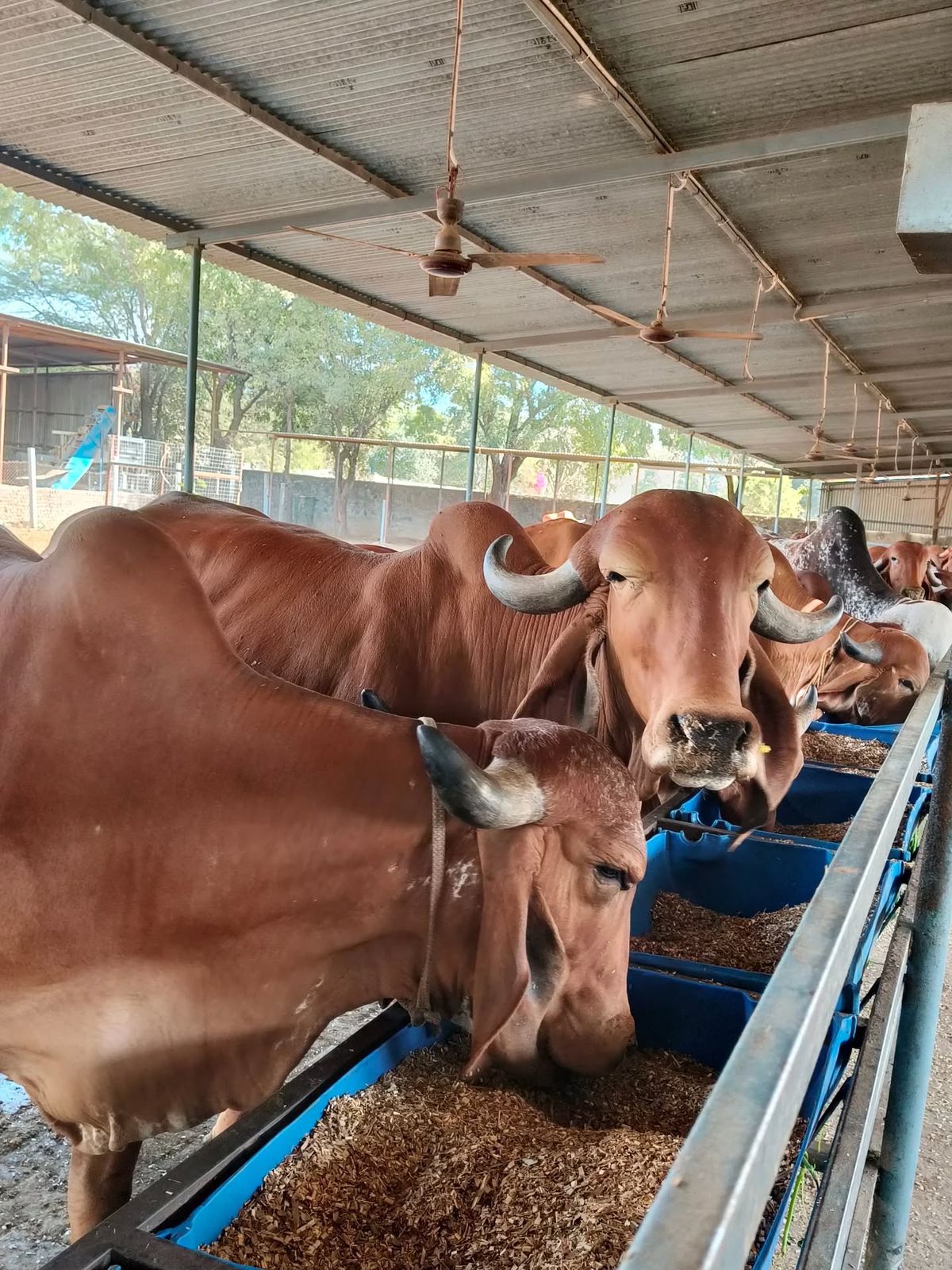
Forehead first. A true Gir has a broad convex forehead, almost a bony shield, overhanging the eyes enough to give her that half-asleep look. Ears long and pendulous, folded like a dried leaf, notched at the tip. Horns sweeping back then curving up. Skin loose and glossy.
The FAO breed description is more precise than any trader's word and costs nothing to read. Then ask which lactation she's in. Then milk her yourself, morning and evening, on two separate days. Not once. Anybody who won't allow that has already told you something.
Cruder tests, more useful ones. Real Gir milk sets a thick cream layer when boiled and cooled, not a thin skin. It turns to curd overnight without any starter heroics. Faint sweetness, slight yellow cast off the carotene, which is where the old golden milk talk comes from.
And it won't taste identical every single day, because a real herd shifts with the season, the fodder and which cows happen to be at peak that month. Milk that tastes engineered usually is.
A purebred Gir gives about 8 to 12 litres per day while she is in milk, and exceptional animals in their third or fourth lactation reach 15. Averaged across a full calving cycle including the dry months, the FAO breed record puts it near 5 litres a day.
It happens, but rarely enough that you should treat the claim as a sales pitch until you've milked the animal yourself. Most videos showing 25 to 40 litres are Girolando cattle, a Gir and Holstein Friesian cross bred in Brazil, not purebred desi Gir.
The FAO breed record reports about 2,063 litres over a lactation of roughly 326 days, and about 1,930 litres over a standard 300-day lactation. Individual herd studies in the same compilation range from around 1,191 kg for first-lactation heifers up to 1,775 kg for mature herd averages.
A Gir eats roughly what a high-yielding crossbred eats but produces a fraction of the volume, takes over four years to reach her first calving, and gives nothing for about four months of every cycle. The price reflects yield per animal, not a premium on the label.
Between roughly 4.69 and 4.97 percent according to the FAO breed record, against about 3.5 percent for typical high-volume crossbred milk. That difference is what produces the thick cream layer on boiled Gir milk.
Two adults drinking tea and the occasional glass need about 1 litre a day. A family of four setting dahi at home usually needs 1.5 to 2 litres. Budget separately if you plan to make ghee, since a kilo of bilona ghee takes roughly 25 to 30 litres of milk.
Purebred Gir carries the A2 beta-casein variant, which is why the breed is sold on that basis. Crossbred animals passed off as Gir may not, which is the practical reason breed verification matters more than any label on a bottle.
About 123 days on average in the FAO breed record, with an inter-calving period near 423 days. Those four dry months are the single biggest reason the daily milking figure and the yearly average sit so far apart.