
That is the Indian figure, set by an FSSAI minimum of 6% fat. The 61 kcal you will find on most sites is American whole milk, a different product.
If the page you just read said 61 or 64, it was not lying to you. It was quoting American whole milk, which carries a different fat content, and it is under-counting your glass by roughly forty per cent.
We run a dairy in Jaipur. This is not a complicated question, but it is one that almost every page answering it gets wrong for an Indian reader, and if you are tracking calories that error compounds every single day. So here is the number, where it comes from, and what changes it.
"Full cream milk" is a legal category in India, not a marketing phrase. FSSAI sets the floor: a milk can only be sold as full cream if it carries a minimum of 6.0% fat and 9.0% solids-not-fat. That is the standard every Indian dairy has to meet, from Amul to the man who delivers to your gate.
American and British "whole milk" sits at roughly 3.25% to 3.6% fat. It is closer to what India calls toned or standardised milk than to full cream. When a global nutrition database says whole milk is 61 kcal, that figure is correct for the product it describes and wrong for the packet in your fridge.
Fat carries 9 calories per gram against 4 for protein and lactose. Nearly doubling the fat is what moves 61 kcal to 87.
If your fitness app is set to "whole milk" and you drink 500 ml of Indian full cream a day, you are under-counting by about 130 calories every day. Over a month that is close to 4,000 calories you never recorded. Switch the entry to 87 kcal per 100 ml, or read the number off your own packet.
Nobody drinks 100 ml. Here is the same milk at the amounts people actually pour, calculated at 87 kcal per 100 ml.
| Serving | Calories | Protein | What that is |
|---|---|---|---|
| 100 ml | 87 kcal | 3.2 g | Half a small cup |
| 150 ml | 131 kcal | 4.8 g | A teacup |
| 200 ml | 174 kcal | 6.4 g | Standard small glass |
| 250 ml | 218 kcal | 8.0 g | One full glass |
| 300 ml | 261 kcal | 9.6 g | Large glass or a big mug |
| 500 ml | 435 kcal | 16 g | Half a litre packet |
| 1 litre | 870 kcal | 32 g | A full day's packet for a family |
One thing worth noticing in that table. A single 250 ml glass of full cream milk carries 8 grams of protein, which is more than two eggs. For a vegetarian household that is genuinely one of the cheapest protein sources available in India.
Calories are the headline, but they are the least interesting thing in the glass. Treat these as a band rather than a label, because they move with the season, the breed and the feed.
| Per 100 ml | Typical | What it does |
|---|---|---|
| Energy | 85–90 kcal | Rises and falls with fat alone |
| Fat | 6.0–6.5 g | Carries vitamins A, D, E and K |
| Protein | 3.2–3.5 g | Complete protein, all nine aminos |
| Carbohydrate | 4.5–5.0 g | All of it lactose, no added sugar |
| Calcium | 120–125 mg | Bone, tooth and muscle function |
| Phosphorus | ~95 mg | Works alongside calcium |
| Potassium | ~150 mg | Blood pressure regulation |
| Vitamin B12 | ~0.4 µg | Hard to get on a vegetarian diet |
| Riboflavin | ~0.18 mg | Energy metabolism |
These fat percentages are the FSSAI legal minimums, not our estimates. This is the section that actually answers the question, because almost nobody buying "full cream" knows it is a regulated number.
| Milk type | Min fat | Per 100 ml | Per 250 ml glass |
|---|---|---|---|
| Buffalo milk | 6.0–7.0% | ~97 kcal | ~243 kcal |
| Full cream | 6.0% | ~87 kcal | ~218 kcal |
| A2 Gir cow | 4.5–5.0% | ~75–80 kcal | ~190–200 kcal |
| Standardised | 4.5% | ~73 kcal | ~183 kcal |
| Toned | 3.0% | ~58 kcal | ~145 kcal |
| Double toned | 1.5% | ~46 kcal | ~115 kcal |
| Skimmed | under 0.5% | ~35 kcal | ~88 kcal |
Read down that fat column and the whole thing becomes obvious. Fat is the only variable doing real work. Protein stays near 3.2 grams and calcium stays near 120 milligrams whether you buy skimmed or full cream, because removing cream does not remove the protein or the minerals.
Which means switching from full cream to toned saves you roughly 73 calories a glass and costs you almost nothing nutritionally, apart from some of the fat-soluble vitamins that travel in the cream.
Roughly half the milk consumed in India comes from buffaloes, and not one of the pages ranking above this one mentions it. If you buy loose milk from a local dairy in Rajasthan, there is a good chance that is what you are drinking.
Buffalo milk runs around 6.5 to 7 per cent fat against 3.5 to 5 per cent for cow milk, so a glass carries roughly 25 more calories. It is thicker, whiter because it has almost no beta-carotene, and it makes better paneer and khoya for exactly that reason. It is also heavier to digest, which is why people who find it sits badly tend to move to cow milk rather than the other way round.
Ask which animal it came from before you log anything. The gap between buffalo and Gir cow milk is nearly 20 calories per 100 ml, and no packet will tell you.
Four things change the figure, and one of them does nearly all the work.
Fat gives 9 calories per gram against 4 for protein and lactose. Every extra 1% fat adds about 9 kcal per 100 ml. This one factor explains nearly the entire spread from skimmed to buffalo.
Buffalo sits highest. Indigenous breeds like Gir run around 4.5 to 5 per cent. Crossbred and Holstein cows sit lower at 3.2 to 3.8 per cent. Same glass, three different numbers.
Fat rises in winter and falls in peak summer. It also climbs as a cow moves later into her lactation. Real milk is a live product, so a two or three calorie drift between months is normal and not a sign of anything wrong.
Watered milk has fewer calories and fewer of everything else. It is the one case where a lower number is bad news. Our guide to checking whether your milk is real takes about ten minutes at home.
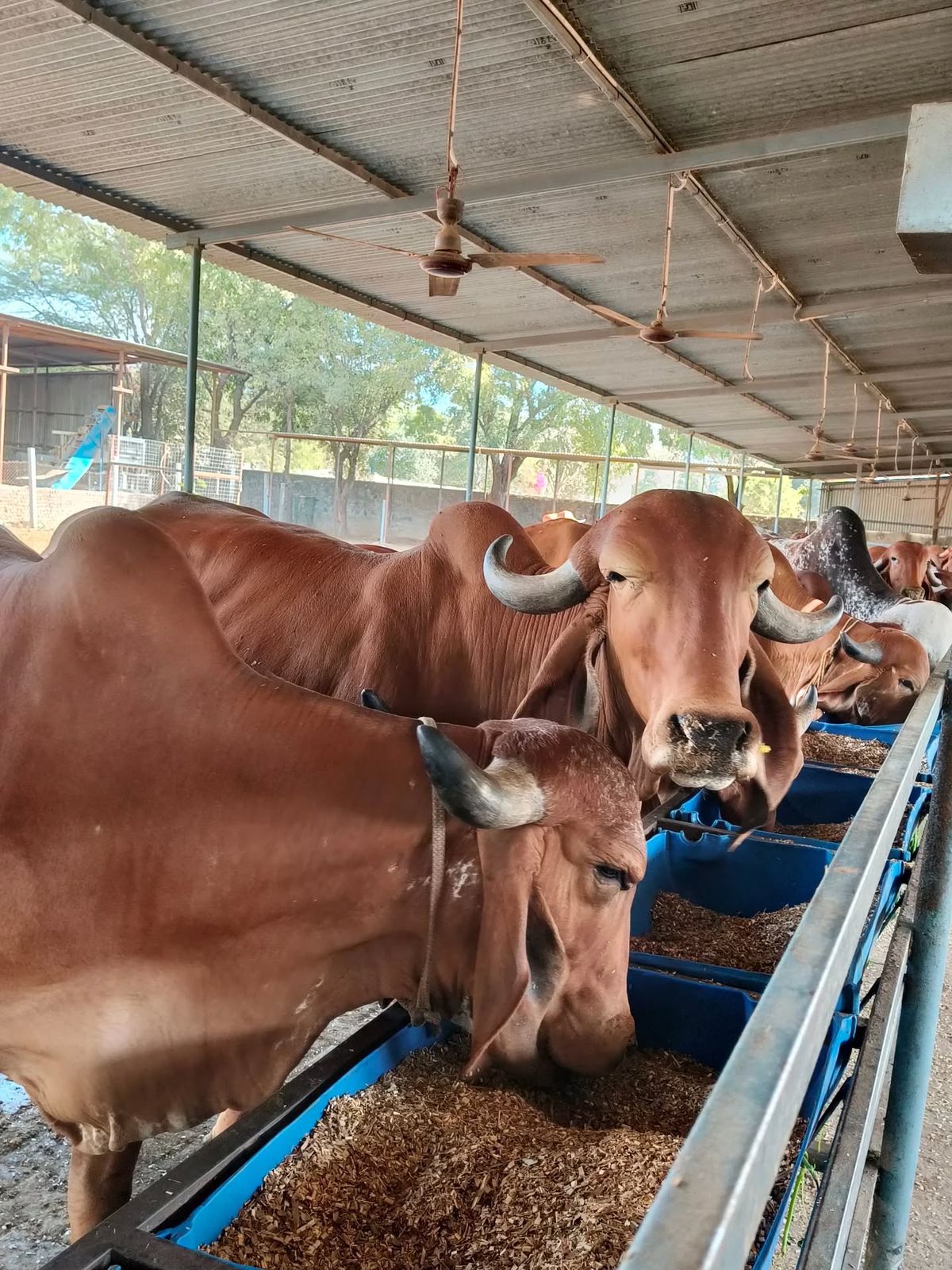
We should be straight about this, since it is our own product. A2 milk from a Gir cow is not a low-calorie milk. It runs about 4.5 to 5 per cent fat, so roughly 75 to 80 kcal per 100 ml. That is lower than packet full cream and higher than toned.
If your only goal is fewer calories, buy double toned milk and save your money. Nobody should switch to A2 for weight loss, and any dairy telling you otherwise is selling rather than informing.
The reason people move to A2 is the protein type, not the calorie count. Indigenous humped breeds carry the A2A2 genotype, which changes the beta-casein in the milk. Plenty of people who bloat on ordinary packet milk report they do not on this. The A1 versus A2 comparison sets out the mechanism, and it is worth saying plainly that the clinical evidence is suggestive rather than settled.
Fresh A2 Gir cow milk from our own herd, delivered across Jaipur between 5 and 9 each morning. Unhomogenised, never reconstituted, never watered, and from one breed so the numbers on this page actually apply.
Book my milkNot automatically, and the honest answer is more interesting than the usual one.
A glass of full cream milk is 218 calories, which is a real amount of food, not a drink you can pour thoughtlessly. Two glasses a day is 436 calories before you have eaten anything. If you are in a deficit and struggling, this is one of the easier places to find room.
But the fat also does something useful. It slows stomach emptying, so full cream milk keeps you full noticeably longer than skimmed does. Large observational studies have repeatedly failed to find the link between full-fat dairy and weight gain that everyone expected to find. Swapping to skimmed and then eating two biscuits at four o'clock leaves you worse off than the glass you started with.
The practical answer: count it properly rather than fear it. Milk is food and belongs in your daily total, not on top of it.
Two teaspoons of sugar in your milk adds 32 calories and 8 grams of sugar. A sachet of flavoured milk powder can add 60 or more. In most Indian households what goes into the glass matters more than which milk went in first.
Growing children, teenagers and anyone underweight are better off with full cream. They need the energy density and the fat-soluble vitamins, and restricting fat in a growing child to save calories is the wrong instinct.
Adults in a calorie deficit generally do better on toned or double toned, because the protein and calcium survive the change and only the calories leave. Anyone managing cholesterol should take the same route, with their doctor's input rather than an article's.
If milk bothers your stomach rather than your waistline, the fat percentage is not your problem and switching to skimmed will not help. Look at lactose or at the protein type instead. Curd and chaas are usually far easier to handle than plain milk, and the benefits of A2 Gir cow milk go into the protein question properly.
About 87 kcal in India, where FSSAI requires full cream milk to carry a minimum of 6% fat. Figures of 61 or 64 kcal that you see online are for American or British whole milk, which is only about 3.25% fat and is a different product.
A 250 ml glass is about 218 kcal with 8 g of protein. A smaller 200 ml glass is about 174 kcal. If you take sugar, add roughly 16 calories per teaspoon on top.
Because 6% is the legal floor, not a ceiling. Brands sit anywhere from 6.0% to 6.5% fat, and some declare per 200 ml rather than per 100 ml. Always check which serving size the label is quoting before you compare two packets.
Skimmed, at roughly 35 kcal per 100 ml, then double toned at about 46. Both keep nearly all the protein and calcium of full cream, because taking the cream out does not remove either. Only the fat and the fat-soluble vitamins go.
It is not a problem if you count it, but at 218 calories a glass it is food rather than a drink. The fat does keep you fuller for longer, and full-fat dairy has repeatedly failed to show the weight-gain link people expect. If you need the room in your day, toned milk is the easier saving.
Yes, about 97 kcal per 100 ml against 75 to 87 for cow milk, because buffalo milk carries 6.5 to 7% fat. It is thicker and whiter, makes better paneer, and is heavier to digest. If you buy loose milk, ask which animal it came from before you log it.
Roughly 75 to 80 kcal per 100 ml, since Gir milk typically runs 4.5 to 5% fat. That puts it below packet full cream and above toned. People choose A2 for the protein type rather than the calorie count, and it is not a weight-loss milk.
Not per gram, but it concentrates them. Boiling drives off water, so the milk left in the pan has more calories per 100 ml than it started with. If you reduce half a litre to 400 ml, the calories have not gone anywhere, they are simply in less liquid.
About 3.2 to 3.5 g, so roughly 8 g in a 250 ml glass. That is more than two eggs, and it is a complete protein carrying all nine essential amino acids. Protein barely changes between full cream and skimmed.
Generally yes. Growing children need the energy density and the fat-soluble vitamins A and D that travel in the cream. Restricting fat in a healthy growing child to save calories is usually the wrong call. Speak to your paediatrician if weight is a specific concern.