
A hundred grams of plain whole-milk dahi gives you roughly three and a half grams of protein. Not eleven, not twelve, whatever a few very large health sites currently have printed on their curd pages. That single wrong number tells you something useful about how this topic gets written: fast, from other articles, by people who have never set a pot of curd or milked the cow it came from.
We run a dairy. Curd is the thing our customers make with our milk every single day, and they call us when it goes wrong. So this page does two jobs at once. It gives you the honest version of what curd does for your body — which benefits are solid, which are wildly oversold, and why "probiotic" is usually the wrong word. And it tells you the part no health portal can, which is how the milk itself decides whether your dahi sets thick and sweet or thin and sour.
Curd is milk that bacteria have partly eaten. That is the whole mechanism, and understanding it explains almost every benefit further down this page.
You add a spoon of old dahi to warm milk. The lactic acid bacteria in it start consuming lactose, the milk sugar, and excreting lactic acid. As the acid builds, the pH falls from about 6.7 towards 4.5. At that point the casein proteins, which had been floating apart because they repel each other, lose their charge, clump together and trap the water and fat around them. The liquid becomes a soft solid. That is the set.
Three things change in that process, and they are the source of everything curd is good for. Lactose goes down, because the bacteria ate a chunk of it. The proteins get partly broken apart, which makes them easier for your gut to finish digesting. And you end up eating an enormous number of live bacteria — fresh dahi typically carries somewhere in the range of ten million to a billion viable organisms per gram.
Which bacteria depends on where you are. Traditional Indian dahi set at room temperature is usually driven by Lactococcus lactis and its relatives, sometimes with Leuconostoc, which is where the mild, faintly buttery flavour of good homemade curd comes from. Warmer sets and commercial yogurt use Lactobacillus delbrueckii subsp. bulgaricus and Streptococcus thermophilus, which work faster and taste sharper. Nobody's kitchen culture is a single clean strain. It is a small ecosystem, and yours is genuinely different from your neighbour's.
These are for plain, unsweetened curd set from whole cow milk. They shift with the fat content of the milk you started from, so treat them as a band rather than a fixed label.
If a page tells you curd has 11 or 12 grams of protein per 100 g, it has confused curd with strained Greek yogurt or with a dry-weight figure. Plain dahi is about 3.5 g. A full 200 g bowl gets you to roughly 7 g — a decent contribution to the day, and nothing like a protein shake. Plan your meals on the real number.
Every article about curd calls it a probiotic. It is worth understanding why that is loose, because the correction actually makes curd more interesting rather than less.
The accepted definition of a probiotic is a live microorganism which, given in adequate amounts, confers a demonstrated health benefit. The load-bearing word is demonstrated, and it is demonstrated per strain. Lactobacillus rhamnosus GG has trial evidence behind it. Some anonymous Lactococcus that has been living in your grandmother's dahi pot for thirty years has exactly as much right to be there and no clinical file at all.
So plain dahi is unambiguously a live-culture food, in large numbers. Whether it is a probiotic in the technical sense depends on strains nobody has identified in your particular pot. Most of these organisms are also transient — they pass through, do useful work on the way, and do not permanently colonise your gut. That is why the benefit fades if you stop eating it.
None of that is a reason to eat less curd. Transient bacteria still ferment, still produce lactic acid, still crowd out less welcome organisms while they are passing, and still bring their own lactase enzyme with them. It is a reason to stop expecting a bowl of dahi to behave like a targeted clinical supplement, and to stop paying extra for cups labelled "probiotic" that carry no strain name and no CFU count. If a product will not tell you the strain and the number, it is selling you the word.
It is far easier to digest than milk. This is the strongest claim on the page and the one with the clearest mechanism. Fermentation removes a meaningful share of the lactose — commonly a quarter to a half, depending on how long it set. More importantly, the live bacteria carry their own lactase, and that enzyme keeps working in your small intestine after you swallow it, helping break down whatever lactose is left. This is why a great many people who bloat badly on a glass of milk eat dahi every day without a flicker of trouble. It is a genuine, well-established effect.
It is one of the best-absorbed calcium sources you can eat. A 200 g bowl carries roughly 250–300 mg of calcium, alongside the phosphorus and protein that bone actually needs to use it. The mild acidity helps keep the mineral soluble through the gut. For Indian diets, where calcium intake is frequently below target and vegetarian sources are limited, this is quietly one of the most valuable things in the fridge.
It helps with appetite, which helps with weight. Protein and fat together slow stomach emptying and blunt hunger far more effectively than a carbohydrate snack of the same size. A bowl of dahi at lunch measurably reduces what people reach for at four in the afternoon. That is the real mechanism — not fat burning, not metabolism, just appetite. It is also the mechanism that actually works.
It is a sensible food for blood sugar. Plain unsweetened curd has a low glycaemic index, and eating it alongside rice or roti slows the glucose release from that meal. Large observational studies have repeatedly found fermented dairy associated with lower type 2 diabetes risk. Association is not proof, and curd will not treat diabetes — but as a swap for a sweet or a packet of biscuits, it is comfortably on the right side of the ledger. Sweetened and flavoured cups are a different food entirely.
It supports blood pressure, modestly. Potassium, calcium and magnesium together are the pattern behind most dietary blood-pressure advice, and curd carries all three. The effect is real and small. It belongs in the same sentence as vegetables and less salt, not in a sentence of its own.
It genuinely helps after antibiotics. This is the one clinical situation where the live-culture argument is strongest. Fermented dairy during and after a course of antibiotics has reasonable evidence for reducing antibiotic-associated diarrhoea. Space it a couple of hours from the dose so you are not feeding the bacteria straight into the drug.
"Boosts immunity." Every curd article says it, usually attached to the statistic that seventy per cent of immune cells sit in the gut. That statistic is roughly right and the conclusion drawn from it is not. Gut bacteria genuinely interact with immune tissue. Nobody has shown that a healthy adult eating dahi gets fewer colds. Eat it because it is good food, not because it is armour.
"Burns belly fat." The chain of reasoning — calcium suppresses cortisol, cortisol drives abdominal fat, therefore curd melts your stomach — is three weak links dressed as a mechanism. Curd helps with weight through fullness. Nothing more exotic is happening, and nothing needs to.
"Detoxifies the body." No food detoxifies anything. Your liver and kidneys handle that continuously and do not need dietary assistance. Any page using the word about a dairy product is not a page to take nutritional advice from.
"Curd gives you a cold." It does not. Curd carries no cold virus. What is real is that something straight out of a cold fridge can irritate an already sore throat, and that thick dairy can make existing congestion feel heavier. Let it come to room temperature and the complaint usually disappears. This is a temperature problem wearing a food's costume.
"Curd lightens your skin." Applied to the face, the lactic acid in curd is a mild alpha-hydroxy acid, and it does gently loosen dead surface cells. That makes skin look brighter, in exactly the way any mild exfoliant does. It does not change your pigmentation. Two or three applications a week is plenty; daily use on dry or sensitive skin tends to leave the barrier worse than it found it.
Curd is an excellent everyday food: digestible protein, well-absorbed calcium, live cultures, low glycaemic load, cheap and available. It is not a medicine and it does not need to be one. The oversold claims are not just harmless enthusiasm — they are what makes people expect results curd was never going to deliver, and then give up on a genuinely good habit.
These four get used interchangeably and they are not the same food. The differences matter if you are counting protein or watching lactose.
Two practical notes. Greek yogurt gets its protein by draining off whey, so per spoon it also carries proportionally less calcium than plain dahi — a trade nobody mentions. And traditional chaas is not weak curd; it is churned curd with the butter removed and water added, which is precisely why it sits so much lighter in an Indian summer.
This is the part health portals cannot write, because it starts at the cow rather than at the bowl.
The firmness of your set is governed almost entirely by solids-not-fat — the protein and lactose in the milk, not the cream. Milk that has been watered has less of both, so it sets into something loose and weepy no matter how good your starter is. If your dahi suddenly turned watery and nothing in your method changed, suspect the milk before you suspect yourself. Our guide to telling real milk from adulterated milk covers how to check that in about ten minutes.
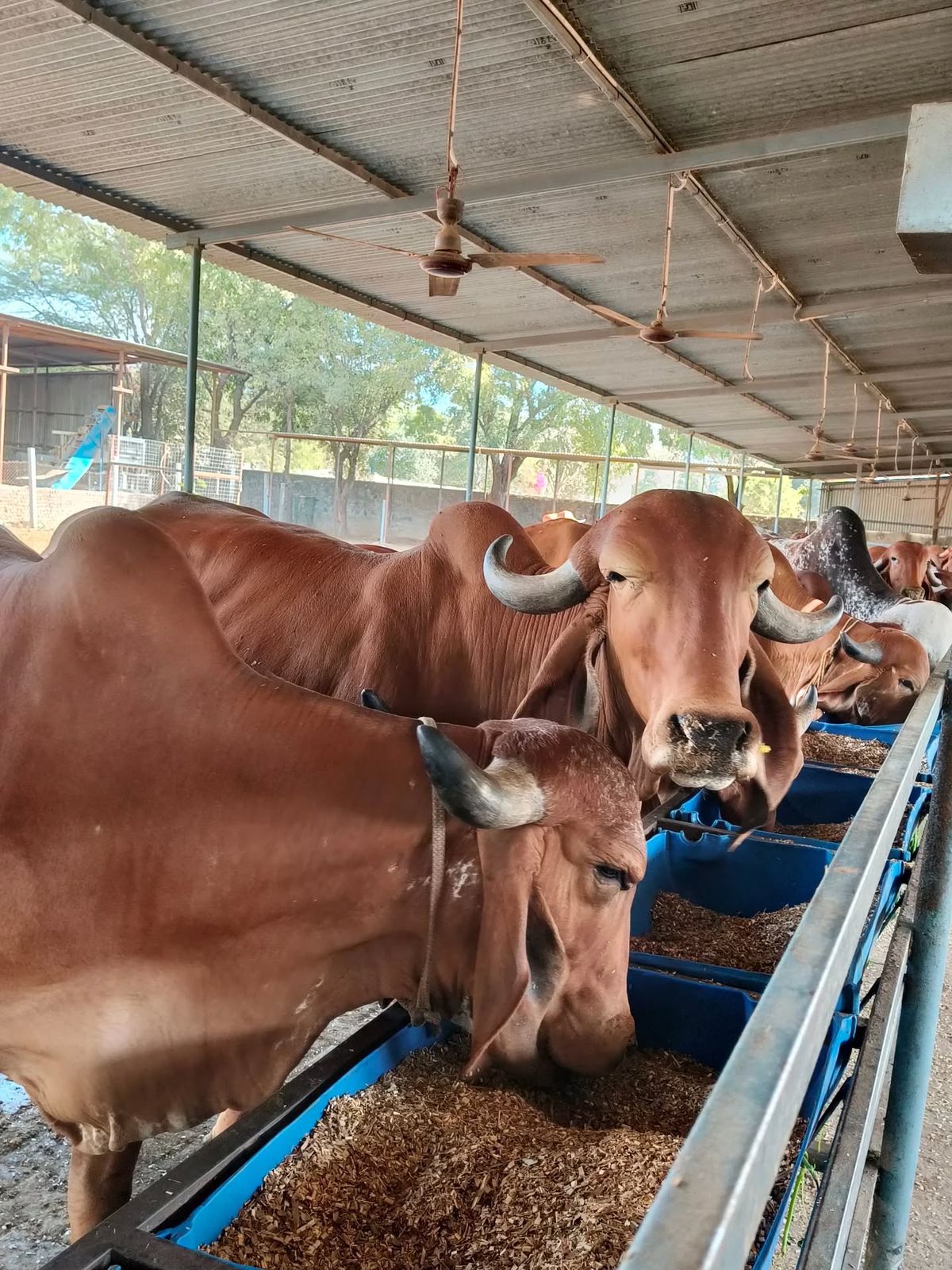
Fat governs mouthfeel rather than structure. Milk from a Gir cow runs near 4.5% fat against roughly 3.2–3.8% from a typical crossbred, and you can taste that difference in the finished dahi immediately — it is creamier, less sharp, and it holds a spoon-shape instead of collapsing.
Then there is the protein type. Gir and other indigenous humped breeds carry the A2A2 genotype, so their milk is A2 milk and the curd set from it is A2 curd. Unlike ghee, where clarification strips the protein out, curd keeps every bit of the beta-casein — so if the A1 protein is what bothers your stomach, this is one of the products where the breed genuinely carries through to your bowl. The A1 versus A2 comparison explains the mechanism, and it is worth saying plainly that the research there is suggestive rather than settled. Plenty of people report a clear difference. The clinical literature has not fully caught up with them.
Fresh A2 Gir cow milk from our own herd, delivered across Jaipur between 5 and 9 each morning. Unhomogenised, never reconstituted, and thick enough to set a bowl of dahi that stands up on the spoon.
These are the calls we actually get, roughly in order of how often the cause turns out to be each one.
By far the commonest cause. Above roughly 50°C you are not culturing the milk, you are cooking the culture. Cool it to about 40–45°C first — a clean finger should sit in it for a few seconds comfortably. Impatience at this step ruins more dahi than everything else combined.
Below about 25°C the bacteria slow to a crawl and you get a thin, sour, half-set mess after twelve hours. In a Jaipur winter, wrap the pot in a towel, put it inside a casserole, or leave it in the oven with only the light on. Warmth is not optional; it is the whole process.
A spoon of week-old dahi from the back of the fridge has very few live organisms left. Use curd that is under three days old, and use enough — about one to two teaspoons per 500 ml. Heat-treated or long-life packaged curd often has no viable culture at all and will never work as a starter.
Dilution strips out the solids that form the gel. The result is a weak set that weeps whey the moment you tilt the bowl. If your method is unchanged and your dahi went thin, test the milk rather than blaming the weather.
The gel forms as a single continuous network. Stir it, shake it or carry it across the kitchen halfway through and you tear that network apart, and it will not rebuild. Set it down somewhere warm and leave it completely alone for four to eight hours.
Sour dahi is not failed dahi — it is dahi left out too long. The bacteria do not stop at the perfect moment. Once it has set, move it straight to the fridge; chilling slows acid production sharply. In a Rajasthan summer that window can be as short as four hours.
The one almost nobody knows. Milk from a cow under treatment can carry enough residue to inhibit the starter culture outright — the milk simply refuses to set, again and again, with perfect technique. Responsible dairies withhold milk from treated animals for exactly this reason. Repeated unexplained failures from one supplier are worth asking about directly.
Boil the milk and hold it at a gentle boil for five to ten minutes. Do not skip this even with pasteurised milk. The heat unfolds the whey proteins so they join the casein network instead of sitting apart from it, and that single step is the difference between a set that stands and a set that slumps.
Cool it to 40–45°C. Warm to a clean finger, never hot. Stir in one to two teaspoons of fresh dahi per 500 ml, mixing just enough to distribute it — a few seconds, not a minute. Pour into your setting pots. Earthenware is genuinely better here, not just romantic: the clay is porous, wicks away a little moisture and insulates, which gives you a firmer, less watery set.
Cover, put it somewhere warm and undisturbed, and forget about it for four to eight hours depending on the season. Then refrigerate the moment it has set. If you want it thicker still, either set it from milk that has been reduced slightly by longer boiling, or hang the finished curd in muslin for thirty minutes — though be aware that hanging drains off whey, and with it some calcium and B vitamins.
A reasonable daily amount for most healthy adults is 100 to 200 grams — one small to medium bowl. There is no strict ceiling; it is food, not a supplement. But it is food with calories and saturated fat, so it should fit into your day rather than sit on top of it.
On the night question, which is asked more than any other: Ayurveda classifies curd as heavy and channel-blocking, and advises against it after dark, particularly in cool or damp weather, with buttermilk suggested instead. Modern nutrition has no objection to dairy in the evening at all. Both can be true in practice. If you have reflux, lying down soon after any substantial food will trouble you, and curd is not special in that. If you have asthma or chronic sinus congestion and you notice a difference, trust your own observation over both traditions. For most people, a bowl of dahi with dinner is entirely fine.
A few things that genuinely matter more than timing. Do not boil it — heating past roughly 50°C kills the live cultures, which is why kadhi and curd-based gravies are nourishing but not live foods. Add curd to hot dishes off the flame if you want the bacteria to survive, and temper it with a little of the warm liquid first so it does not split. Skip the sweetened, flavoured cups: they carry a startling amount of added sugar and undo most of the blood-sugar advantage. Season instead with black salt, roasted jeera or a little rock salt, all of which are traditional and none of which cost you anything nutritionally.
Be careful with curd if you have a diagnosed dairy allergy, in which case avoid it entirely — fermentation reduces lactose but does not remove milk protein. If you are managing cholesterol, use a lower-fat set. And if you have severe lactose intolerance rather than mild, start with a few spoons and see how you get on rather than a full bowl.
Milk, curd, chaas and ghee all come off the same animal and do genuinely different jobs. Milk carries the most protein and calcium per glass but is the hardest on a sensitive gut. Curd keeps nearly all of that nutrition and removes much of the difficulty, which makes it the best daily choice for most people. Chaas is the lightest and the best answer to a Rajasthan afternoon. Ghee keeps only the fat — no protein, no calcium, no lactose — which is why the benefits of Gir cow ghee read so differently from these.
If you want to go further on the milk side, the health benefits of A2 Gir cow milk covers it properly, identifying genuine desi cow milk covers sourcing, and you can meet the cows behind ours if you would rather see than read.
Yes, for most healthy adults. A bowl of 100 to 200 g a day of plain, unsweetened curd is a sensible habit — it is one of the better-absorbed calcium sources available, and it is easier on the gut than milk. Fold it into your daily calories rather than adding it on top, and skip the sweetened cups.
About 3.1 to 3.5 g in plain whole-milk dahi, so roughly 7 g in a 200 g bowl. If you have seen a figure near 11 or 12 g, that belongs to strained Greek yogurt or is a dry-weight number — it is not plain curd. Greek yogurt genuinely does reach 9 to 10 g per 100 g, because the whey has been drained off.
Modern nutrition has no objection. Ayurveda advises against it, especially in cool weather, and suggests buttermilk instead. In practice: if you have reflux, lying down after any heavy food will bother you and curd is not special. If you have asthma or sinus trouble and you notice a difference, trust your own experience. Otherwise it is fine — let it come to room temperature first.
Usually yes, and often very comfortably. Fermentation removes a good share of the lactose, and the live bacteria carry their own lactase enzyme that keeps working in your gut. Start with a few spoons if your intolerance is severe. A true dairy allergy is a different matter — fermentation does not remove milk protein, so curd is not safe there.
The culture. Traditional dahi is set with whatever mixed wild strains live in your starter — usually Lactococcus types, which give a milder, faintly buttery flavour. Commercial yogurt uses two defined strains, L. bulgaricus and S. thermophilus, which set faster and taste sharper. Nutritionally they are close to identical.
It is definitely a live-culture food, carrying somewhere between ten million and a billion organisms per gram. Whether it is a probiotic in the strict sense is another question, because that term requires a named strain with demonstrated benefit, and nobody has characterised the strains in your kitchen pot. The bacteria are also mostly transient. Real benefits, looser word.
Most often the milk was too hot when you added the starter — above about 50°C kills the culture. Next likeliest: the room is below 25°C, the starter was old and dead, or the milk was watered and lacks the solids to form a gel. Also possible: you moved it while it was setting. Rarely, antibiotic residue in the milk inhibits the culture outright.
Sour means it sat out too long after setting — the bacteria do not stop on their own, so refrigerate as soon as it is firm. In summer that window can be four hours. Watery usually means low milk solids, either from a naturally thin milk or from dilution, and boiling the milk longer before setting will help.
It helps, through appetite rather than metabolism. Protein and fat together slow stomach emptying and reduce what you eat later in the day. The popular calcium-cortisol-belly-fat argument is far weaker than it sounds. Plain curd as a swap for a sweet or a snack is a genuinely useful move; it is not a fat burner.
Plain unsweetened curd has a low glycaemic index and slows the glucose release from the meal it accompanies, and fermented dairy is repeatedly associated with lower type 2 diabetes risk in large studies. It is a good food in a diabetes diet, not a treatment. Flavoured and sweetened varieties carry enough added sugar to reverse the benefit entirely.
It destroys the live cultures above roughly 50°C, so kadhi and cooked curd gravies have no viable bacteria left. The protein, calcium and B vitamins survive perfectly well. If you want the cultures, stir curd into a dish off the flame, tempering it with a little warm liquid first so it does not split.
Yes, two or three times a week. The lactic acid is a mild alpha-hydroxy acid and gently loosens dead surface cells, which is why skin looks brighter afterwards. It does not lighten pigmentation, whatever the claims say. Daily use, particularly on dry or sensitive skin, tends to damage the barrier rather than help it.
Yes, and more meaningfully than with ghee. Ghee is clarified, so almost no beta-casein survives into it. Curd keeps the protein intact, so A2 milk really does give you A2 curd. Whether that matters for you depends on whether A1 dairy troubles your digestion — many people report it does, though the clinical evidence is suggestive rather than settled.
Four to five days refrigerated, though it keeps souring slowly the whole time and is at its best in the first two. Always use a clean, dry spoon — introducing crumbs or water is what turns curd mouldy rather than merely sour. Keep back a spoonful from a fresh batch as your next starter, not from a five-day-old bowl.